
The MX1: Unpacking How Pleated Leather Made a Signature Jean
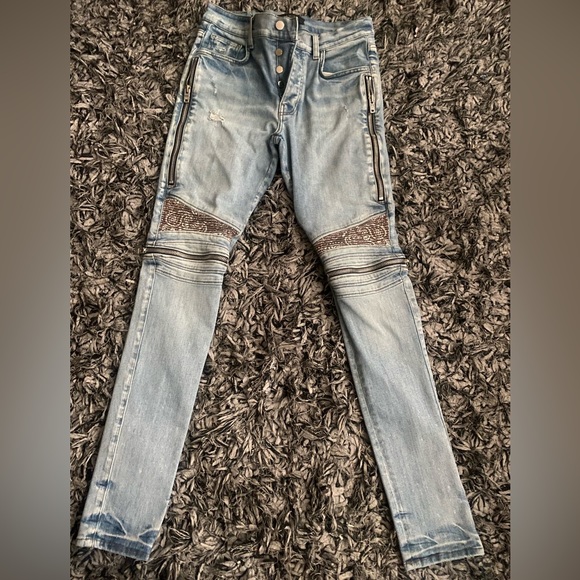
Most luxury houses hinge on one product that decodes the rest of the line, and for this Los Angeles label that product is the MX1. Think of it as a skinny five-pocket jean distressed by hand and afterwards repaired with pleated leather inserted into the thinned places. The observed market price is $1,090, which makes it the dearest item in the core denim range and the piece the whole category is judged against. It is not the cheapest jean here, nor the newest, nor the most extreme, and it is still the one people mean when they say amiri jeans. What comes next sets out how a repair technique became a house signature, what the jean is constructed from, and which recycled claims collapse on checking. All figures quoted are observed market listings and never an official price list.
A Maxfield capsule, plus a founding date that stays unsettled
Mike Amiri started the label in his hometown of Los Angeles, and the brand’s own about page puts the year at 2014. The CFDA carries it, so does the Italian group that later took a minority stake, and so does the standard encyclopedia entry. Cutting the other way, a press release dated 3 December 2014 locates the founding in 2013 and describes it as a partnership with the luxury retailer Maxfield. Both sources can be cited, so the fair way to put it is that the brand dates itself to 2014 while the earliest contemporaneous release says 2013. What is not contested is the launch vehicle, an exclusive capsule collection at that Los Angeles concept store. Those capsule jeans were already performing what the MX1 does today, so the model reads as a first principle rather than a later addition.
What he was doing before all this
Brand copy and the CFDA use the same careful wording about the founder’s start, saying he began by hand-crafting unique stage pieces for legendary Los Angeles performers. That is the extent of what either source amiri sale asserts, and the specific rock clients named in retailer editorial are secondary reporting rather than brand statement. The safe formulation is that he is widely reported to have made stage pieces for particular performers, not that the brand says so. According to the same 2014 release, he had over ten years in the luxury market and had worked up projects for Helmut Lang, J Brand and RRL. None of that is confirmed by those companies, so it is brand public relations and should be labelled as such. Also in that release, and left out of most coverage, is his appointment as head designer of ready-to-wear and accessories at Buscemi.
The specification behind the jean
Per the official copy it is a skinny-fit jean cut from Italian stretch denim, finished with classic five pockets, worn by hand and repaired with pleated leather. Ovine leather is the stated contrast material, so neither an unspecified leather nor a synthetic. The composition runs as 92 percent cotton, 6 percent elastomultiester and 2 percent elastane, and the jean sits in the Core Collection. Origin is the USA, which counts both as a point about the brand and as an authentication check. Style codes use a structured format, so any code should stay consistent with both the style and its colourway. Pleated panels are seated into the abraded zones at knee and thigh, which means the leather sits where denim is missing rather than on top of intact fabric.
What the pleating is really for
The construction is the argument for the price, and it is worth being precise about it. Distressing alone is cheap to imitate, but a repair that replaces missing denim with a shaped leather insert is a second operation on top of the first. Pleating that leather adds a third, because a pleated panel has to be formed before it can be set into an irregular opening. Hand finishing means the openings never repeat, which rules out cutting every panel from one template. That irregularity is also the most reliable at-a-glance authentication tell, because counterfeit distressing tends to be repetitive and flat. Faking it at volume is the real obstacle, which is fitting, because this is the product.
One structural idea, a whole run of variants
Once the repair position exists, anything can occupy it, and that is how the variants work. On the MX1 International, pleated bandana print replaces the leather in exactly the same structural position. The MX1 Bandana Jacquard does the move with a woven paisley, and Stud and Aloha versions apply hardware and print to that same base. The colour range takes in black, several indigo washes and white. Bandana and Crystal are treatments rather than fits, which is why filing them under fits misleads, and either can land on the MX1, the Thrasher or the Shotgun alike. The table separates the base jean from the treatments that ride on it.
| Style name | What changes | Detail |
|---|---|---|
| MX1 | Repairs in pleated ovine leather | Base jean, observed $1,090, made in the USA |
| MX1 International | Pleated bandana print replaces the leather | Identical structural position |
| MX1 Bandana Jacquard | Plain leather gives way to woven paisley | The fit is unchanged, the treatment is not |
| Stud MX1 | Metal studding worked onto the base | Priced in the upper band |
| Aloha MX1 | A printed motif over the base | Seasonal, not permanent |
| Baggy MX3 | Its own motocross-inspired hybrid | Womenswear, observed $990, never a step above the MX1 |
Price now, and resale later
The observed full price is $1,090, set against $750 for the Stack jean at the far end of the core range. Resale behaves differently, with listings on the main denim resale platform clustering roughly between $480 and $650 and a wider spread from about $400 to $840. Because specialised materials depreciate harder, the suede and unusual-material versions take the lower end. Structurally it comes down to discounting, since authorised retail cuts visibly by roughly 40 to 70 percent in-season and off-price channels come next after that. That sale floor caps what a secondary buyer will pay, and high counterfeit density adds an authentication discount on top. None of this is investment advice, and the reasonable reading is that the MX1 is a garment to wear rather than to hold.
Living with a pair
Sizing is buyer-reported rather than published, since complete measurements are not released for every style. The cut is deliberately narrow, and although the waist runs broadly true to the labelled inch, the leg is what sends people up a size. Buyers with muscular thighs or calves commonly report going up one or two for a slim rather than skinny line. Care is more demanding than ordinary denim, since core pairs are spot-clean only, with no washing, bleaching, tumble drying, ironing or dry cleaning. The care copy also flags intentional shading variation and possible dye transfer, both characteristics of the finish rather than defects. The checks below are the ones worth running before money changes hands.
- Make sure the origin label says USA, as a jean marked made in Italy does not match the core denim
- Confirm the style code is structured and matches both the style and the colour
- Make sure the contrast material is named as ovine leather and not left unspecified
- Look for hand distressing that is irregular and asymmetric, not repeating machine abrasion
What gets said about the MX1 and is not true
Top of the list is a numbered ladder, going MX1 for leather, MX2 for bandana and a third model for heavier destruction. Nothing verifies it, and it reads like search-optimised copy copied from site to site, because the brand’s own site carries only one MX3, a women’s Baggy MX3 at an observed $990. That piece is a no-waistband, motocross-inspired hybrid, not a men’s tier above the MX1. MX2 is a real name, yet its collection pages returned no live products when checked in 2026, and sources split over whether its defining feature is contrast inserts or zippered knee vents. Reading MX as motocross is a defensible inference from the MX3 description, but it stays an inference rather than a brand statement about the MX1 name. The claim that all amiri clothing is made in Los Angeles is false as well, since the MX1, the Stack and the core amiri hoodie are US-made while amiri sneakers are made in Vietnam.
How the MX1 functions now
No style in the current range has taken its place. It remains part of the Core Collection, remains at the top of the standard denim band, and remains the model resale platforms build dedicated browse pages around. Roomier cuts have taken volume away from the skinny shapes, and buyers looking at amiri men now have Carpenter, Baggy and MA Fit options that did not define the early years. That has made the MX1 more of a reference than a default, which is a normal life cycle for a signature product. The safest route is still the brand’s own channel or a retailer named on its published stockist list, because no official outlet exists. Anything advertising itself as one is, by the brand’s own legal position, not the brand.